
Effective treatment of lumbar hernia without surgery in Germany
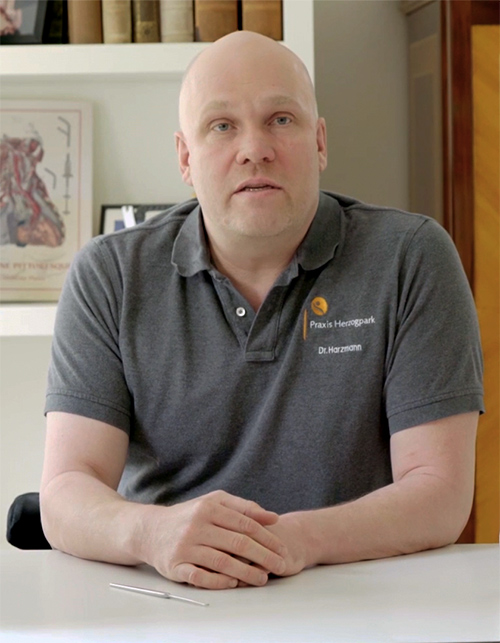
Dr Hanns Hartzmann
MD.
Dr Hanns Hartzmann, chief physician of the German Olympic Football Team, Bayern Munich Basketball Club. Certified massage therapist, physiotherapist, osteopath and surgeon - specialist in conservative and minimally invasive treatment of the spine and musculo-ligamentous injuries. Previously Head of the Department of Spine Surgery at the University Hospital of Munich. Specialities: unique combination of specialised knowledge and experience with the musculoskeletal system as a practising massage therapist and osteopath, as well as many years of experience in spinal surgery as a surgeon.
Intervertebral herniations most commonly occur in the lumbar region, the most vulnerable area of the spinal column. Among the causes of lumbar hernia formation are osteochondrosis, spinal injuries, excessive physical exertion, and insufficient mobility. The disease is most often observed in 30-50-year-old men.
Timely accurate diagnosis and qualified non-surgical treatment of lumbar herniated discs can fully restore the disc and lead the disease to complete regression.
MedicalConnectionsGmbH organises non-surgical treatment of cervical hernias in Germany at a high level. An experienced doctor of the German Olympic football team and Bayern Munich basketball team successfully carries out conservative treatment with the use of innovative methods, ensuring the desired result - full restoration of all functions and return to service.

Symptoms of the disease
Hernias of the lumbar spine are manifested by three main clinical syndromes:
1. Pain - increasing in intensity as the hernia progresses and increases in size.
2. Vertebral - limitation of mobility in the lumbar region, curvature of the spine, violation of the autonomic nervous system.
3. Root - deterioration of tissue nutrition due to the dying off of the roots of the spinal cord, as a result of which the muscles of the thighs, lower legs and feet lose tone, atrophy begins, paralysis and complete disability may occur.
Diagnosis of the disease

Already at the first examination, an experienced doctor can make a preliminary diagnosis, focusing on the characteristic symptoms of lumbar intervertebral hernia.
Approximately 90% of lumbar disc herniation occurs at the level of the vertebrae L4-L5 or L5-S1. When the S1 nerve root is affected, the patient cannot stand on his toes - the ankle reflex disappears, pain and numbness can be felt in the calf or the outer part of the foot. When the L5 nerve root is affected by herniation, numbness is noted in the big toe and the foot itself. The pain may be felt in the thigh and buttock.
To make an accurate diagnosis, German clinics use various methods based on the latest achievements of medical science and technology: To make an accurate diagnosis, German clinics use various methods based on the latest achievements of medical science and technology:
- MRI is the gold standard for diagnosing intervertebral hernias;
- MRI in motion - Stand up MRT;
- Myelography - radiography of the spinal cord with contrast.
- Lumbar puncture.
- Electromyography.
After conducting a set of diagnostic studies, doctors develop the optimal treatment tactics, individualised for each specific case.
Conservative treatment of lumbar hernia without surgery
Based on the data of diagnostic examination, treatment of the lumbosacral spine is prescribed individually, taking into account the severity of the pathology, the severity of clinical symptoms, anamnesis, the age of the patient and the presence of concomitant diseases. The decisive priority for German specialists is the choice of the most gentle and safe for the organism methods.
Methods of lumbar hernia treatment without surgery

- Drug therapy - the prescription of drugs that control pain and inflammation, vitamins, means that improve blood circulation.
- Epidural catheterisation according to Rats - elimination of irritation of nerve fibres with the help of medicinal solutions that have anti-edema, anti-inflammatory and resorbing effect.
- Percutaneous laser decompression - under the influence of a laser, the size of the herniated disc is reduced, the growth of cartilage tissue is stimulated, thus restoring the disc between the vertebrae.
- PRP - injection of autologous enriched platelet-rich plasma extracted from the patient's whole blood.
- Other treatment methods.
Conservative treatment of the lumbosacral spine includes massage, therapeutic gymnastics, physiotherapy. Procedures restore the condition of ligaments, back muscles, improve blood circulation, fill the spine with necessary microelements and vitamins.
The leading German doctor specialising in non-surgical methods of spine treatment, accredited by the Olympic Committee and FIFA, Dr Hartzmann, uses author's excellent proven methods of recovery after conservative treatment of intervertebral hernia. Thanks to competent treatment and subsequent comprehensive rehabilitation measures, patients are able to return to work and continue their professional activities.
It is quite easy to get to Germany for lumbar hernia treatment with the help of our company. Call us and tell us about your problem. We take care of the rest.
Call us! Our coordinators will answer all your questions about treatment in Germany:
Телефон: +49 89 922 79 655
Факс +49 89 922 79 656
Email: Этот адрес электронной почты защищён от спам-ботов. У вас должен быть включен JavaScript для просмотра.


