
The Ratz epidural catheter method
Our expert:
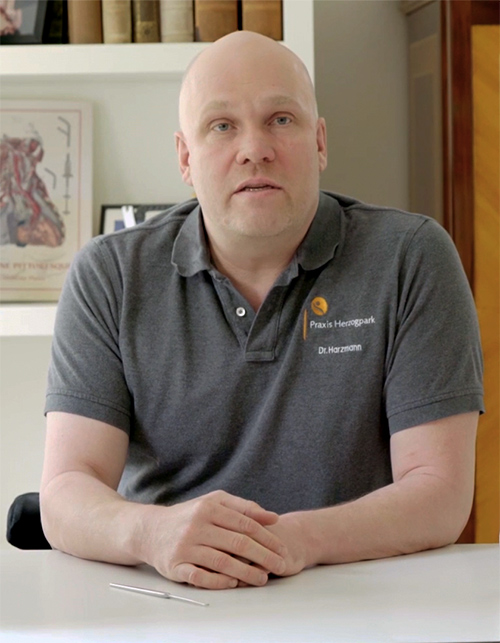
Dr Hanns Hartzmann
MD.
Dr Hanns Hartzmann, chief physician of the German Olympic Football Team, Bayern Munich Basketball Club. Certified massage therapist, physiotherapist, osteopath and surgeon - specialist in conservative and minimally invasive treatment of the spine and musculo-ligamentous injuries. Previously Head of the Department of Spine Surgery at the University Hospital of Munich. Specialities: unique combination of specialised knowledge and experience with the musculoskeletal system as a practising massage therapist and osteopath, as well as many years of experience in spinal surgery as a surgeon.
Conservative techniques for the treatment of the spine:
Preliminary investigations required:

In order to plan the procedure, it is recommended that appropriate imaging data of the spine region to be treated (cervical spine, thoracic spine, lumbar spine) in the form of radiographs or computed tomography (CT) or ideally magnetic resonance imaging (MRI) be submitted. In addition, as part of the planning and prior to this intervention, a neurological examination is recommended in selected cases to rule out subsequent neurological underlying causes (pain) if possible. In addition, the epidural catheter intervention should not be performed against the background of long-term/continuous use of blood thinning drugs (aspirin, Plavix, clopidogrel, Marcumar, etc.).
ЛTreatment with Racz epidural catheterisation is usually performed under so-called analgo-sedation by anaesthesiologist colleagues. Thus, an appropriate anaesthesia protocol should be established and further investigations should be performed if necessary before the intervention being performed.
What clinical pictures in the spinal region can be successfully treated with the so-called epidural catheterisation technique?
Epineurolysis and epidural catheter implantation are promising treatment methods if, according to a sufficiently detailed examination, the causes (of the disease) are irritation of the nerve roots due to compression - e.g. by intervertebral disc material - or degenerative processes. Therefore, in addition to the imaging diagnosis, a follow-up examination using an appropriate infiltration scheme (so-called segmental periradicular infiltration therapy (PRT)) is recommended. In this way, the relevant spinal segments can be very well identified, allowing the best therapeutic success for epidural catheter placement. Generally, the therapeutic options of so-called epidural catheterisation go beyond just one segment or nerve root. However, this option is only possible in the context of primary care and catheter implantation on the first interventional day.

Epidural catheter implantation is most promising for significant disc protrusions or herniations that do not require urgent microsurgical/endoscopic treatment. On the other hand, epidural catheter placement is categorically excluded in the case of persistent paralyses or paresthesias that have not been resolved after PRT.
Treatment with epidural catheterisation is particularly promising in the case of the so-called post-nucleotomy syndrome. These are pains occurring after operations on intervertebral discs, with formation of corresponding scars or with redisplaced intervertebral discs, which do not require emergency and repeated surgical intervention. This is possible in this case. With the method of so-called epidural catheterisation, existing adhesions can be easily and reliably removed in the process of so-called neurolysis.
Indications for so-called epineurolysis with the Racz catheter:
Symptomatic intervertebral disc protrusions and moderate to severe intervertebral disc herniations, segmental narrowing of the intervertebral foramen and spinal canal, post-nucleotomy syndrome or post-discectomy syndrome.
How does the so-called epineurolysis using the Racz catheter work?
Using the lower epidural catheter, a special flushing catheter can be guided in the spinal canal with millimetre precision to the most causal point of compression. This special catheter can be successfully advanced via a remote puncture and a special soft probe under the control of an image converter to the exact location of the respective disc problem. In doing so, it is usually possible to approach and place the catheter up to the L1- L 2 level.
The principle of action of these epidural catheters is explained by the removal of so-called adhesions by means of a controlled ‘flushing’ with fluid and the resulting dissolution of tissue layers. In addition, the catheter tip can be used to treat localised and severe inflammatory changes in the area of the nerve roots in a targeted manner, as well as directly affecting intervertebral disc tissue such as so-called sequestrations. This is not classical epineurolysis, but rather a therapeutic approach that allows the intervertebral disc material protruding outwards to be ‘dissolved’ in an appropriate manner. In addition, the effect of a so-called enzyme preparation called ‘hyalase’ was also used in the past. It was guaranteed that the intervertebral disc material could be ‘digested’ and consequently destroyed. Because of the significant complications, we modified our treatment regimen accordingly, maintaining only the local inflammatory ‘cascade’ through intensive saline flushing and a special anti-inflammatory ‘cocktail’; in this way we activate the body's ability to self-repair to the extent that it manages to optimally reduce the amount of intervertebral disc material and destroy it.

Epidural catheterisation procedure:
When performing an epineurolysis, the patient is placed on the abdomen and our anaesthesiologists immerse him or her in a light superficial anaesthesia by means of the so-called analgo-sedation method. Subsequently, the area of intervention is abundantly flushed to a sterile state and covered with a sterile cover. The entry point is located in the extension of the lumbar spine, in the region of the lower third of the sacrum. The anatomical entrance gate, the so-called sacral orifice, is located here. After local anaesthesia is administered and a special probe is inserted, this entry point, covered with a thin membrane, can be punctured, and under the control of X-rays, these needles can be placed in such a way that a catheter can be inserted inside the spinal canal without any complications. The catheter is then advanced 2 levels - up to the segment to be treated - under the control of the image converter. Here the height/level is re-determined using a contrast agent, allowing this localisation procedure to be performed perfectly. In individual cases, it is possible to advance the catheter, for example, to a segment higher up, to carry out the appropriate therapy there, and then to move the catheter to a segment lower down to carry out the appropriate therapy there as well. In this way, up to three segments can be treated simultaneously in 1 session. Accordingly, no ‘filling’ can be performed on the remaining segments on subsequent days. Then the corresponding nerve roots or intervertebral discs are flushed through a special filter system. To do this, we inject 2 ml of naropin through a particle trapping filter. This is followed by flushing with 10 ml of saline. As an anti-inflammatory agent, a corticosteroid (Triam 10/40) is administered without a particle filter, followed by a washout of 2-3 ml of naropin with a particle filter. Finally, the position of the catheter is checked again and the catheter is secured at the point of entry into the skin with a so-called traction suture. Using a large-area dressing, the catheter is closed appropriately on the back and remains well covered with elastic padding for the next 2 days.

Immediately after the procedure, the patient should remain in bed for one to two hours. A little later, it is possible to get up without problems (initially with the help of the nursing staff). The procedure is usually inpatient and therefore it is important to be seen by a doctor for two days to prevent unwanted displacement of the catheter. On the first postoperative day, the catheter is examined in the supine position and filled according to its filling pattern. On the second postoperative day, the same pattern is repeated and then the catheter is removed. In individual cases, it may be necessary to remove the catheter already on the first postoperative day due to inflammatory changes as well as anatomical narrowing to avoid subsequent mechanical irritation.
After the so-called epidural catheterisation therapy, the patient should not undergo high physical exertion for 10-14 days. In some cases it is recommended to wear a so-called lumbar orthosis. If necessary, the individual recommended exercise or rehabilitation programme should be started no earlier than 10-14 days after the intervention.
In individual cases, it may be necessary to repeat the epineurolysis with an epidural catheter after a certain period of time in order to achieve - if possible - an optimal non-operative result.
Therapeutic possibilities and successes of epidural catheter therapy:

In general, so-called epineurolysis and epidural catheter implantation can be used to treat high-grade disc protrusions and herniated discs with great success in a minimally invasive and only interventional way. In this way, a more serious surgical intervention can be completely avoided if the case has not reached the point of severe numbness and paralysis. The chances of success of this epidural therapy with appropriately good preoperative assessment and planning are 80-90% for the symptoms described in this text.
The individual risk profile of the so-called epidural catheter intervention is limited to the local entry point in the sacral region. Accordingly, this is a general risk of surgical infection, the particularity of which is that microbes from the outside can be introduced through this catheter into the epidural space. This means that, in individual cases, broad-spectrum antibiotic therapy may be required prior to interventional intervention.


