
Our expert:
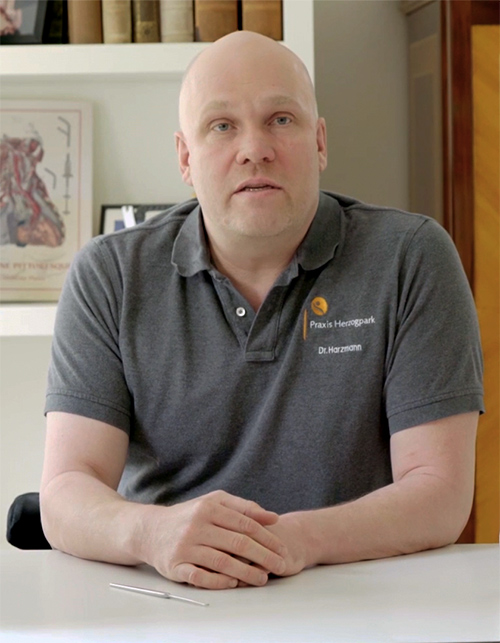
Dr Hanns Hartzmann
MD.
Dr Hanns Hartzmann, chief physician of the German Olympic Football Team, Bayern Munich Basketball Club. Certified massage therapist, physiotherapist, osteopath and surgeon - specialist in conservative and minimally invasive treatment of the spine and musculo-ligamentous injuries. Previously Head of the Department of Spine Surgery at the University Hospital of Munich. Specialities: unique combination of specialised knowledge and experience with the musculoskeletal system as a practising massage therapist and osteopath, as well as many years of experience in spinal surgery as a surgeon.
Statistically, about half of the adult population of the world suffers from back pain. And only 15-20% of people at the occurrence of painful sensations turn to specialised medical institutions. The rest of patients seek help for chronic conditions of the spine, when symptoms are present all the time.

Diseases of the spine are dangerous because they can involve the surrounding muscles, joints and sometimes other organs of our body in the pathological process. For example, in professional sports due to the pathology of the spinal column often arise damage to the knee joint and Achilles tendon, and the configuration and function of the thoracic spine very strongly affect the arthrokinematics of the shoulder joint, also often leading to damage to its structures. In everyday life, people suffer from constant pain, dizziness, inability to do the necessary work, which naturally has a negative impact on the quality of life.
Causes of intervertebral hernia:
Back pain can occur due to uncharacteristic sudden movement, a fall, a blow, lifting weights, incorrect posture, heavy load during fitness classes, as well as age-related changes. As a consequence, there is a deterioration of mobility of a certain part of the spine, muscle atrophy and loss of stability. This is often accompanied by structural damage and changes, among which the most common are protrusions and herniated discs at various levels.
Diagnosis:

- Examination by a neurologist.
- Examination with an orthopaedic doctor.
- Magnetic Resonance Imaging (MRI)
- Computer tomography (CT)
- X-ray radiography
- Electromyography
Methods of treatment in Germany:
The main methods of spinal hernia treatment are conservative and surgical.
According to German specialists, the surgical method is indicated in case of vertebral body fractures, in case of postoyan pain syndrome and serious neurological symptoms, which can be expressed in loss of motor function, numbness, hypersensitivity in the absence of effect from conservative therapy.
Methods of surgical interventions include endoscopic, open and minimally invasive, such as nucleoplasty.
The disadvantages of surgical methods include a high risk of recurrence, which is approximately 30%. This can be expressed, for example, in the formation of adhesions, scars, which in turn often re-compress the nerve roots. The probability of such problems is almost impossible to assess preoperatively.

Treatment of intervertebral hernia without surgery in Germany
Conservative method of treatment of intervertebral hernia is the use of non-steroidal anti-inflammatory drugs, identification and elimination of dynamic disorders and changes, as well as mandatory treatment and rehabilitation.
Methods of non-surgical treatment of intervertebral hernia: infiltration of facet joints, intradiscal injection, epidural catheterisation with local injection of anti-inflammatory drugs according to the method of Prof. Rach, thermodenervation and many others.
The above methods are aimed at reducing pain syndrome, relieving inflammation and dehydration of tissues, ‘shrinking’ herniated disc. The body is able to reduce the size of the hernia itself, but it often takes 1-2 years to do so. Also this process is complicated by inflamed nerves and pain sensations. By using anti-inflammatory non-steroidal therapy in German clinics, we help to speed up this process.
The patient usually feels relief after the first treatment session. After a few sessions, the pain sensations go away. At this point, a certain number of patients make a mistake. They think that the treatment is over and they can go back to their daily life and sports. The result is a resurgence of pain. In fact, conservative treatment of intervertebral hernia allows us to eliminate only a consequence of the problem, namely, the pain syndrome. The cause of the changes is a violation of biomechanics, deterioration of stability and mobility of the spinal column, muscle atrophy. The consequence is a dynamic overload of the spine.

Rehabilitation after non-surgical hernia treatment in German clinics
For successful conservative treatment, German specialists recommend a systematic approach, namely, anti-inflammatory therapy combined with therapeutic and restorative rehabilitation, in the process of which the biomechanics of human movements is analysed, static and dynamic disorders involving the spinal column and limbs, manual therapy, osteopathy, acupuncture, correction of disorders through the use of specific functional exercises aimed at restoring the mobility of the spine and building up the musculoskeletal system. The rehabilitation course in Germany is designed for 12 days. At the end of the treatment, the patient receives specific recommendations that relate to his or her condition, which allows for the prevention of similar problems in the future.


