
Our expert:
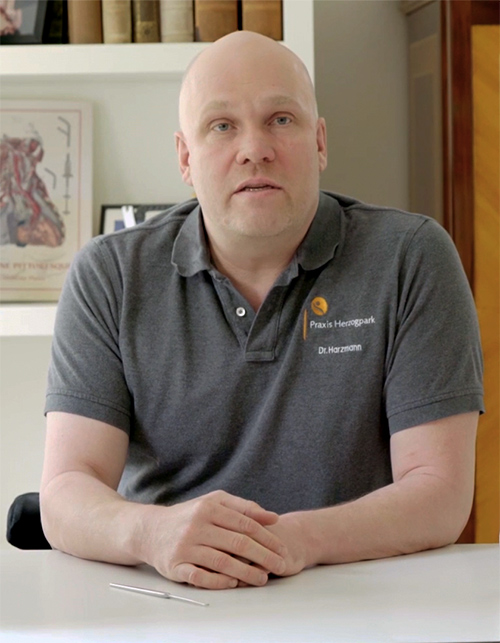
Dr Hanns Hartzmann
MD.
Dr Hanns Hartzmann, chief physician of the German Olympic Football Team, Bayern Munich Basketball Club. Certified massage therapist, physiotherapist, osteopath and surgeon - specialist in conservative and minimally invasive treatment of the spine and musculo-ligamentous injuries. Previously Head of the Department of Spine Surgery at the University Hospital of Munich. Specialities: unique combination of specialised knowledge and experience with the musculoskeletal system as a practising massage therapist and osteopath, as well as many years of experience in spinal surgery as a surgeon.
Periarticular infiltration therapy (‘flushing’ of the nerve root).
Preliminary investigations required:
In order to plan the procedure, it is recommended to provide appropriate imaging data of the spinal region to be treated (cervical spine, thoracic spine, lumbar spine) in the form of a computed tomography (CT) scan or ideally a magnetic resonance imaging (MRI) scan.In addition, in order to plan the so-called periarticular infiltration therapy, a neurological examination is recommended if necessary - in individual cases - to rule out other neurological underlying causes (pain) if possible.Due to the close proximity of the yuk to the peridural and epidural space, it is imperative to enquire about taking blood thinning medication.
What clinical pictures can be successfully treated with periradicular infiltration therapy (PRT)?

First and foremost, PRT is used to provide anti-inflammatory treatment of trapped nerves in the area of nerve exit points in all parts of the spine, as well as in the epidural and peridural spaces.Most often, this kind of inflammation of nerve roots occurs under the influence of mechanical irritation, due to sharply pronounced disc protrusions or due to severe disc displacement (disc herniation), which can exert direct or indirect pressure on the nerves passing nearby.As a result of mechanical irritation caused by this material of the intervertebral disc, an inflammatory process occurs in the area of the nerve roots, which, in turn, can lead to severe pain sensations, a feeling of numbness, up to the loss of motor function.In addition, inflamed nerve roots sometimes swell, as a result of which they continue to pinch in the places where the nerve exits.
With more pronounced degenerative changes in the spinal column, mechanical narrowing of nerve exit points can occur against the background of the so-called stenosis of intervertebral foramen or stenosis of the spinal canal.In this case, the impinging structures are not only fragments of intervertebral discs, which directly narrow the nerves, but rather bone changes in the area of the spinal canal and facet joints.These clinical pictures are referred to as spinal canal stenosis or intervertebral foramen stenosis and manifest as pain that irradiates to the legs or arms, as well as fatigue-related fatigue symptoms that can subsequently lead to, for example, the well-known ‘intermittent claudication’ in the leg region.
Indications for periradicular infiltration therapy (PRT):
Acute chronic recurrent lumboischialgia, disc herniation, disc prolapse, disc prolapse, disc stenosis, spinal canal stenosis, neurogenic intermittent claudication syndrome
How does the so-called PRT work?

Periradicular infiltration therapy (PRT) is a minimally invasive and gentle method of treating nerve structures and tissues surrounding nerves. Using a special needle and under the control of an image converter, the exit point of the nerve roots to be treated is located in the lateral projection. Then, after local anaesthesia of the skin by inserting a special needle over the passing nerve, the inflammatory structures are washed out, thus reaching the spinal canal and the epidural space. In the so-called PRT in combination with local anaesthesia in most cases, medications such as vitamin B preparations and corticosteroids are used, which allow to stop or mitigate the inflammatory processes occurring in the nerve root. In case of pronounced intolerance to corticosteroids, other drugs can be injected into the area of nerve roots.This will be discussed with the patient on a case-by-case basis.
PRT is an individually planned outpatient minimally invasive intervention or so-called intervention under local anaesthesia.Needle placement can cause short-term typical back pain and then significantly reduce discomfort.After the completion of the intervention, the patient is able to move independently.But in individual cases, due to anaesthesia of the corresponding nerve roots in the area of the legs or arms, a temporary limitation of sensitivity and motor skills may be observed. In these cases, driving a car or taking part in road traffic is prohibited for several hours.
PRT procedure:

In PRT, the patient is placed on the abdomen, the target area is sterilely treated; then anatomical landmarks are identified using an image transducer and local anaesthesia is administered.A special needle is then inserted into the structure to be treated at a special angle through the so-called intervertebral foramen, either laterally or posteriorly - using variable methods. This is carried out under local anaesthesia and is completely painless. In individual cases, the patient may experience typical short-term localised pain.The inflamed area is then washed with a local anaesthetic and an appropriate therapeutic ‘cocktail’, enveloping the nerve.Usually, relief of pain in the area of the treated nerves comes relatively soon.As a side effect of the anaesthetic, there may be a short-term sensory disturbance or reduction in strength in the muscles supplied by the nerve in question.
The capabilities and therapeutic strategy of PRT:

PRT allows us to quickly and effectively treat acute and recurrent painful conditions in the area of trapped nerve pathways.In addition, performing so-called PRT allows us to perform diagnostics that allow us to conclude whether and to what extent further or more intensive interventions or surgical procedures will be successful.In individual cases, it may be necessary to perform several consecutive infiltrations of so-called PRT in the cervical, thoracic or lumbar spine at intervals.Based on the results of the clinical examination, appropriate decisions can then be made about subsequent interventional or surgical treatment.
Along with facet joint infiltration, PRT is the most effective spinal analgesic therapy we know of that can sufficiently manage or eliminate acute or chronic pain conditions.In addition, these infiltration techniques reduce the consumption of oral pain medications and therefore reduce the side effect profile of intensive analgesic therapy. A limiting factor is that regular administration of so-called PRT or the use of other infiltration techniques at short time intervals (e.g., using corticosteroids) is promising only in exceptional cases and may also lead to the development of more serious complications, depending on the frequency of application and dosage.


