
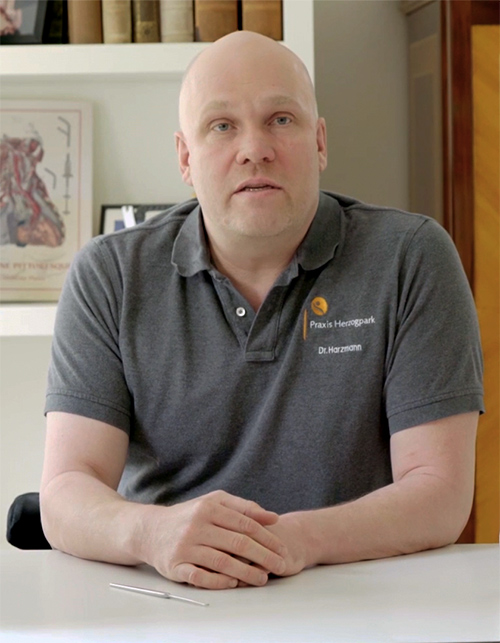
Dr Hanns Hartzmann
MD.
Dr Hanns Hartzmann, chief physician of the German Olympic Football Team, Bayern Munich Basketball Club. Certified massage therapist, physiotherapist, osteopath and surgeon - specialist in conservative and minimally invasive treatment of the spine and musculo-ligamentous injuries. Previously Head of the Department of Spine Surgery at the University Hospital of Munich. Specialities: unique combination of specialised knowledge and experience with the musculoskeletal system as a practising massage therapist and osteopath, as well as many years of experience in spinal surgery as a surgeon.
Epidural steroid injections (ESIS)
Epidural steroid injections (ESIS) are a common treatment option for many forms of back pain. They began to be used in 1952 and are still an integral part of conservative treatment today. The goal of a steroid injection is to control pain. A single injection is usually sufficient to achieve relief, but they are usually used in conjunction with a comprehensive rehabilitation programme to achieve a lasting effect. The goal of epidural steroid injection is to deliver the drug directly (or very close) to the source of pain generation. In contrast, oral (TABLETS, POWERS, ORAL CAPSULES) steroid and analgesic medications have a less focused effect and may have side effects
Typically, a solution containing cortisone or another steroid drug with a local anaesthetic such as lidocaine and/or saline is used.

Typically, a solution containing cortisone or another steroid drug with a local anaesthetic such as lidocaine and/or saline is used.
Steroid injections are performed in the epidural space around the nerve roots of the spinal cord to relieve pain caused by irritation of the spinal nerves. The steroid is used to reduce inflammation of these nerves, which is often the source of pain.
Steroid injections are often performed into the facet joints that connect the vertebral arches to each other. Inflammation in the facet joints is the cause of over 40% of cervical spine pain.
It is important to understand that steroid injections should not be viewed as a drug for back and neck pain alone, but rather as a tool whose purpose is to help patients to complete a full rehabilitation programme.
Radiofrequency neurotomy (ablation)

Radiofrequency neurotomy is based on applying heat to the specific nerve conduit that is the source of pain in order to stop the transmission of pain signals to the brain and thus achieve a permanent analgesic effect while maintaining sensation and movement in the affected spinal segment.
Radiofrequency neurotomy refers to minimally invasive surgery and is performed under fluoroscopic guidance to ensure clear needle guidance to maximise the effect and prevent complications.
Radiofrequency neurotomy is usually performed if conservative treatment has not been effective. The advantages of this procedure are a long period without pain, on average about 2 years, a fast recovery period, increased motor activity and a fairly low rate of complications.
The entire procedure usually takes between 30 and 90 minutes and patients go home the same day.
Prolotherapy ("Proliferative Injection Therapy")

Prolotherapy is a drug injection procedure to treat connective tissue, including those of post-traumatic genesis, that has not been healed by rest or other conservative treatments. Injections of the drug substance are administered at sites where ligaments and tendons attach to bone tissue, which promotes healing of swollen and weakened tissue to alleviate back pain and improve function. Prolotherapy is also referred to as sclerosing therapy, sclerotherapy, regenerative therapy, ‘proliferative’ injection therapy, and non-surgical ligament repair.
Good rates ranging from 80% to 90% have been reported when there was a persistent positive effect following these procedures, such as:
- Reduction or elimination of back pain
- Increased strength of the ligament, tendon, or joint capsule
- Absence of recurrence of injury in the treated area
- Improvement or complete restoration of function of the injured segment.
Prolotherapy involves a series of injections, reported in a range of 3 to 30 (average 4 to 10), depending on the condition of the individual being treated. A series of Prolotherapy injections can span 3 to 6 months with breaks of 2 to 3 weeks.
It is important to note that approximately 90% of people with acute back pain experience a positive effect after conservative treatments within 6 to 8 weeks and do not require further surgical treatment.


